
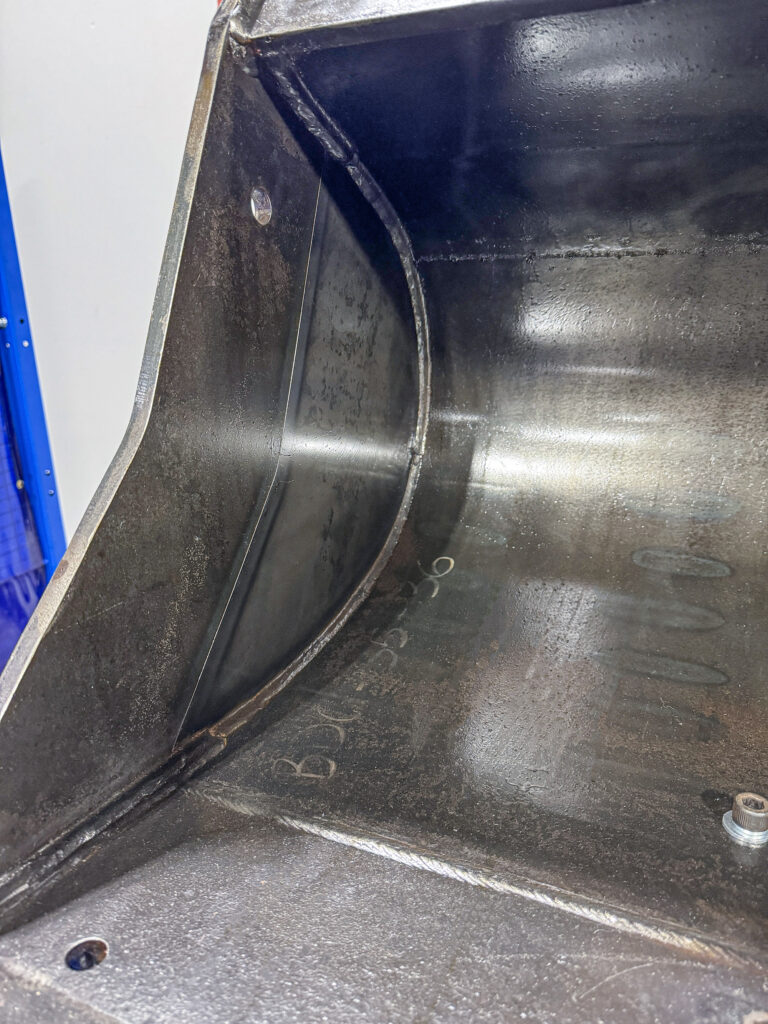
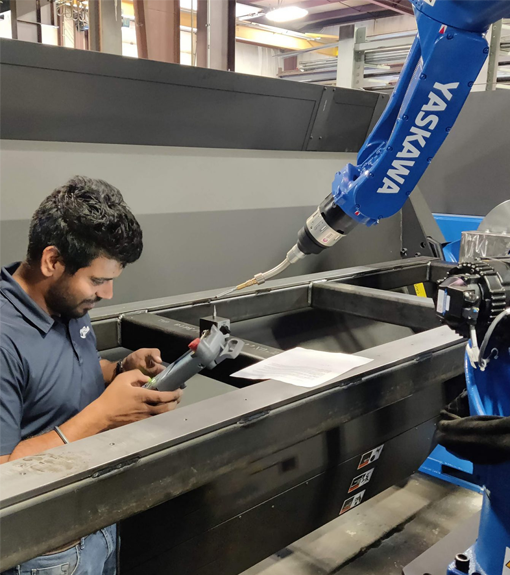
Attachments are the components mounted on construction and agricultural equipment—excavator buckets, claws, and various equipment-mounted tools. These parts are used across construction, agriculture, and other heavy equipment industries. They have intricate designs with fingers, deep insides, and shallow outsides. They’re not simple squares or standard geometries.
Attachment manufacturing represents a perfect example of high-mix, low-volume production with extreme customization:
Attachment manufacturing has stayed highly manual because of this complexity. Most manufacturers still hand-weld these parts today. This is where Mach Machines’ high-mix capabilities make automation viable.
Attachment manufacturers face a problem that traditional robot integrators can’t solve. You might build 10 buckets in one width today, 15 in a different width tomorrow, and custom configurations next week. Every part can be different.
Traditional teach pendant programming takes 8+ hours per new part. Your expensive robot sits idle while you could finish the job by hand. That’s why attachment manufacturing has stayed manual—until automation technology caught up to the complexity.
Mach Machines has mastered how to handle complicated attachment geometries and all the customization that comes with this type of manufacturing.
Attachment welding requires specialized capabilities to handle complex shapes, thick materials, and high-mix production:
Complex attachment geometries require multi-axis positioners like sky hooks and tilt-turn systems. Maintaining a wire-down position keeps the weld puddle stable and prevents running or drooping. Circular-to-circular joints—common in attachment manufacturing—require simultaneous two-axis movement to maintain proper weld position throughout the joint.
The robot and positioner move simultaneously while welding. Our VC software automatically solves external axes, making high-mix programming realistic for the complex geometries common in attachment manufacturing. This synchronized coordinated motion is essential for maintaining optimal weld position on complicated shapes.
Similar parts with minor variations—longer, wider, scaled, different dimensions—adjust automatically rather than requiring complete reprogramming. The software detects similar geometry and applies previous welding parameters automatically. This is a major time-saver when you're programming different bucket configurations daily.
Attachments need thick, strong welds to withstand digging, scraping, and impact with the ground and walls. Multi-pass welding builds up weld material layer by layer, like building Legos, filling the entire V-joint progressively to achieve the required strength. Seam tracking becomes especially critical for multi-pass welding. Each pass compounds potential error—even a perfect first pass isn't perfectly straight. Subsequent passes need to follow the actual weld location rather than the programmed path, or errors multiply across multiple passes.
Attachments wear down from harsh use—digging, scraping, hitting the ground and walls. After approximately 10 years of service, the material becomes too thin and strength is compromised. Cladding welds layers on top to build thickness back up, creating a "blanket" of weld material with multiple passes back and forth. We can program cladding operations for attachments using the same multi-axis positioning flexibility required for complex geometries. This extends equipment life by refurbishing worn components rather than replacing them.
Attachment manufacturing involves fit-up variations from manual assembly. Our Server Robot vision technology accommodates the imperfect part presentation that's common in this type of manufacturing. Seam tracking is particularly important for multi-pass applications where fit-up variations compound across multiple weld passes.
Our attachment automation serves both agriculture and construction equipment manufacturers. Both industries face the same challenges: complex shapes, extreme customization, and manual processes that need automation. We focus on the application type—attachments—rather than industry-specific solutions, since the welding challenges are similar across both sectors.
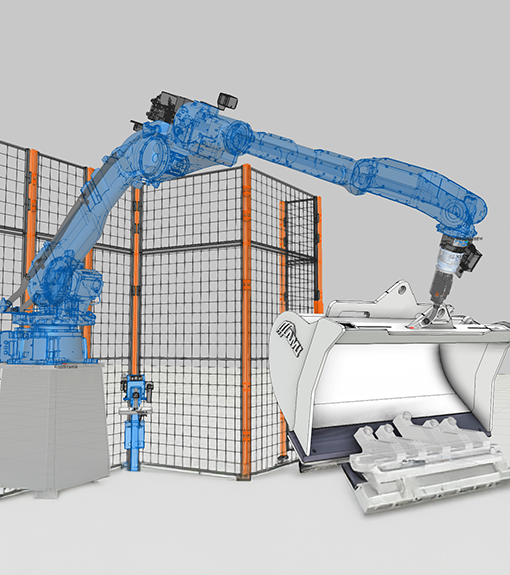
Attachment manufacturing requires capabilities most integrators don’t offer: multi-axis positioning for complex shapes, parametric programming for extreme customization, and seam tracking for fit-up variations. We’ve built our automation approach around these exact requirements.
Our automation solutions include:
Contact our team to discuss automating your attachment manufacturing and find the right solution for your production needs.
High-mix production becomes viable when you have the right programming tools and multi-axis positioning capabilities. We specialize in the complex geometries and extreme customization that define attachment manufacturing.
Our VC Robotics offline programming software includes parametric programming capabilities. When parts have minor variations—different bucket widths, tooth counts, or dimensions—the software detects similar geometry and adjusts the program automatically. This eliminates complete reprogramming for each variation, making high-mix production viable.
Attachments require thick, strong welds to withstand harsh conditions. Multi-pass welding builds up material layer by layer to fill the entire joint and achieve the required strength. Seam tracking is critical because each pass compounds potential error—subsequent passes must follow the actual weld location rather than the programmed path.
Yes. Cladding repairs worn attachments by welding layers on top to rebuild thickness after years of harsh use. We program cladding operations using the same multi-axis positioning capabilities required for complex attachment geometries, extending equipment life through refurbishment.
4460 Lake Forest Drive, Suite 210
Cincinnati, Ohio 45242
© 2025 Mach Machines